
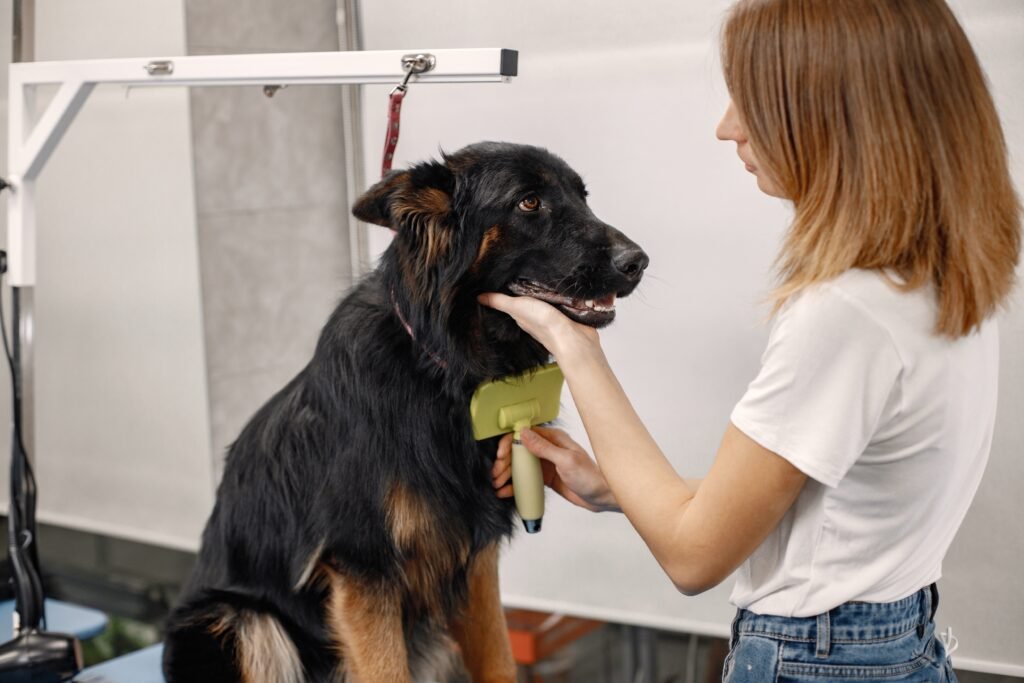
Do Dogs Know They Are Being Groomed? Understanding What Your Dog Really Experiences
If your dog has ever watched you suspiciously as you reach for the brush—or suddenly become excited when you pull into the grooming salon parking lot—you may have wondered:
Does my dog actually know they’re being groomed?
The answer is fascinating. Dogs probably don’t understand “grooming” as a beauty or hygiene appointment in the human sense. But they are remarkably good at recognizing routines, environments, people, objects, and the sequence of events associated with grooming.
Your dog may recognize the brush. They may know the sound of the clippers or dryer. They may remember their groomer. And they can certainly learn what usually happens before, during, and after a grooming appointment.
More importantly, dogs experience grooming physically and emotionally. Understanding that experience can help you make grooming safer, calmer, and more positive throughout your dog’s life.
Do Dogs Understand What Grooming Is?
Not in the same way we do.
You understand that your dog is getting a bath because their coat needs cleaning, their nails need trimming for healthy movement, or their haircut will make their coat easier to maintain.
Your dog doesn’t necessarily understand those long-term reasons.
Instead, dogs learn primarily through association, repetition, and consequences.
For example, your dog may learn that:
Brush comes out → brushing begins → treat follows.
Or:
Car ride → grooming salon → familiar groomer → bath and haircut → reunion with owner.
After enough repetition, these events become predictable.
So while your dog may not think, “It’s time for my grooming appointment,” they can absolutely recognize the routine associated with one.
Can Dogs Recognize Their Groomer?
Yes, many dogs can recognize familiar people, including their regular groomer.
Dogs use several forms of information to identify people and environments, particularly:
Scent
Voice
Body language
Routine
Previous experiences
This is one reason consistency can be so valuable.
A dog who repeatedly visits the same salon and develops a positive relationship with a familiar groomer may become increasingly comfortable with the experience.
For some dogs, that relationship becomes an important part of successful lifelong grooming.
Do Dogs Know When They Are Going to the Groomer?
Some certainly seem to recognize the clues.
Dogs are exceptionally attentive to patterns in our behavior. Your dog may notice:
A particular car route
Their grooming bag or leash
The entrance to the salon
Familiar smells
The groomer’s voice
The sound of grooming equipment
A dog who has experienced the same routine repeatedly can begin anticipating what happens next.
Their reaction will largely depend on what they have learned to associate with that experience.
Do Dogs Enjoy Being Groomed?
Some dogs genuinely appear to enjoy certain parts of grooming.
Others simply tolerate them.
And some find particular procedures stressful.
A dog’s response can depend on:
Early socialization
Previous grooming experiences
Temperament
Age
Coat condition
Physical sensitivity
Handling techniques
The grooming environment
A dog may love gentle brushing but dislike nail trimming. Another may enjoy bathing but feel uncomfortable around a high-velocity dryer.
That’s why experienced groomers don’t assume every dog will respond the same way.
They watch the individual dog.
How Can You Tell If Your Dog Is Comfortable During Grooming?
A relaxed dog may display behaviors such as:
Loose, comfortable body posture
Willingly approaching the groomer
Relaxed facial expression
Taking treats normally
Settling during brushing or drying
Recovering quickly after unfamiliar sounds or handling
These behaviors should always be interpreted in context.
Not every quiet dog is necessarily relaxed. A dog that becomes unusually still may also be experiencing stress.
Professional handling involves observing the entire dog rather than relying on one signal.
Signs Your Dog May Be Stressed During Grooming
Dogs communicate discomfort primarily through behavior and body language.
Potential signs of grooming-related stress include:
Repeated lip licking
Excessive panting unrelated to heat
Trembling
Trying to move away
Tucked tail
Ears held back
Avoidance
Vocalization
Sudden resistance
Attempts to hide
Defensive behavior
One stress signal doesn’t automatically mean a dog is having a terrible experience. Context matters.
However, repeated or escalating signs should never simply be ignored.
A skilled groomer adjusts handling, positioning, pacing, and breaks according to the dog’s needs whenever possible.
Why Early Grooming Experiences Matter
One of the best things you can do for a puppy is introduce grooming before extensive grooming is actually necessary.
Early positive exposure can include:
Touching the paws
Handling the ears
Gentle brushing
Brief baths
Introducing grooming tools
Standing calmly on a safe surface
Becoming accustomed to dryer sounds from an appropriate distance
The objective isn’t to force a puppy through a lengthy grooming session.
It’s to teach:
“These sensations are normal, predictable, and safe.”
That foundation can make an enormous difference later in life.
Do Dogs Feel Better After Grooming?
Many dogs may be noticeably more comfortable after appropriate grooming, particularly when the appointment removes something that was physically bothering them.
Proper grooming can address:
Loose undercoat
Dirt and debris
Excessively long nails
Hair obstructing certain areas
Mild tangles before they become severe
Coat buildup
However, grooming should never be framed purely as cosmetic.
For many breeds, routine coat, skin, ear, paw, and nail maintenance is an important part of overall care.
A beautiful haircut is simply one visible result.
Why Matted Dogs May Experience Grooming Differently
Matting changes the grooming experience considerably.
Tightly tangled hair can pull on the skin and make ordinary handling uncomfortable. Severe matting may also limit the styling options available because attempting to brush it out can cause unnecessary discomfort.
This is why regular home maintenance and professional grooming appointments are so important.
Preventing mats is generally far more comfortable than removing them after they have become severe.
Does Your Dog Know They Look Different After a Haircut?
This is where we should be careful not to humanize dogs too much.
There’s no good reason to assume your dog looks in the mirror and evaluates their new haircut the way you might after leaving a salon.
What they can notice are physical changes.
Their coat may feel lighter. Mats may no longer pull against their skin. Their nails may feel different against the floor. Their face may have less hair around it.
They may also react to something else entirely: you.
Your enthusiastic voice, affection, attention, and body language after grooming can become part of the positive experience.
So when your freshly groomed dog walks around the house looking exceptionally proud, we may be contributing to that confidence more than we realize.
How to Make Grooming a More Positive Experience
You can help your dog develop healthier associations with grooming long before the next appointment.
At home:
Handle paws, ears, legs, and face gently and regularly.
Introduce brushes gradually.
Reward calm behavior.
Keep practice sessions short.
Never aggressively pull through painful mats.
Avoid turning every grooming interaction into a struggle.
Maintain a regular professional grooming schedule appropriate for the coat.
Most importantly, don’t wait until grooming becomes an emergency.
A dog whose coat is routinely maintained usually has a very different experience from one who arrives with severe matting, overgrown nails, or months of accumulated undercoat.
Why Choosing the Right Groomer Matters
Technical skill matters—but so does the ability to work with dogs.
A professional groomer should understand more than haircut patterns. They should be able to recognize canine body language, adapt handling to different temperaments, use appropriate equipment, and know when a dog needs a break or when a procedure should not continue.
For discerning pet parents, the goal shouldn’t simply be finding someone who can make a dog look beautiful.
It should be finding a professional who values appearance, safety, comfort, and the dog’s overall experience.
Frequently Asked Questions
Do dogs understand when they are being groomed?
Dogs probably don’t understand grooming as a hygiene or beauty service the way humans do. However, they can recognize the people, places, tools, sensations, and routines associated with grooming and learn to anticipate what happens next.
Do dogs remember their groomers?
Dogs can recognize familiar people and can develop associations with regular groomers based on scent, voice, environment, handling, and previous experiences.
Why does my dog act differently after grooming?
Your dog may be responding to physical changes in their coat or nails, excitement about seeing you again, stimulation from the grooming environment, fatigue, or the attention they receive afterward.
Can dogs be afraid of grooming?
Yes. Some dogs experience grooming-related fear or stress, particularly after unpleasant experiences or when they haven’t been gradually introduced to handling and grooming procedures.
Can dogs learn to enjoy grooming?
Many dogs can develop much more positive associations with grooming through gentle handling, gradual exposure, rewards, consistency, and appropriately paced professional grooming.
Final Thoughts: Your Dog Understands More Than You May Think
So, do dogs know they are being groomed?
Not exactly in the human sense.
Your dog probably doesn’t understand why a haircut is necessary or why nail maintenance contributes to comfortable movement. But dogs are excellent at recognizing patterns and forming associations.
They learn the sounds.
They recognize the tools.
They remember the environment.
They recognize familiar people.
And, most importantly, they remember how an experience makes them feel.
That’s why great grooming isn’t simply about creating a beautiful coat. It’s about building trust through repeated, safe, predictable experiences.
When grooming is approached with patience, expertise, and respect for canine behavior, it can become more than routine maintenance—it can become a familiar part of a dog’s lifelong care.